Modern science is astonishingly successful.
We can predict planetary motion with extreme precision, manipulate matter at atomic scales, and reconstruct the early universe using equations that work uncannily well. And yet, beneath this success, a quiet unease persists.
We calculate confidently—but struggle to say what is really going on.
Physics today often finds itself in a peculiar position. Gravity works, yet we debate endlessly about what gravity is. Quantum mechanics predicts outcomes with stunning accuracy, yet resists coherent interpretation. Cosmology balances its equations by introducing dark matter and dark energy—names for what we cannot yet conceptualize.
This is not failure. It is a conceptual strain.
Historically, such moments have not been resolved by better calculations alone, but by changing the metaphors through which reality itself is understood.
That is where Nested Reality enters.
When Explanation Works but Understanding Feels Thin
Equations tell us how things behave. They do not always tell us why those behaviors must occur.
Newton calculated gravity while refusing to speculate about its nature. Einstein replaced force with geometry, reshaping motion itself. Quantum theory dissolved classical objects into probabilities and interactions. Each advance preserved predictive power while quietly unsettling older intuitions.
Nested Reality follows this tradition—not by rejecting modern physics, but by asking a deeper question:
What if the problem is not our mathematics, but the conceptual primitives we take for granted?
From Force to Structure
One of the most radical moves in Nested Reality is also one of the gentlest.
It does not deny force as a useful calculation. It questions force as a primitive of reality.
We have never observed force directly. What we observe is motion—change in position, configuration, or state. Force enters afterward as an explanatory compression. At human scales, we already accept imbalance as explanation: a body slides because a configuration cannot persist. Only at larger scales do we insist on invisible pulls.
Nested Reality simply asks: Why should scale change ontology?
If imbalance is sufficient locally, perhaps it is sufficient universally.
From Particles to Density
The book makes a similar move with particles.
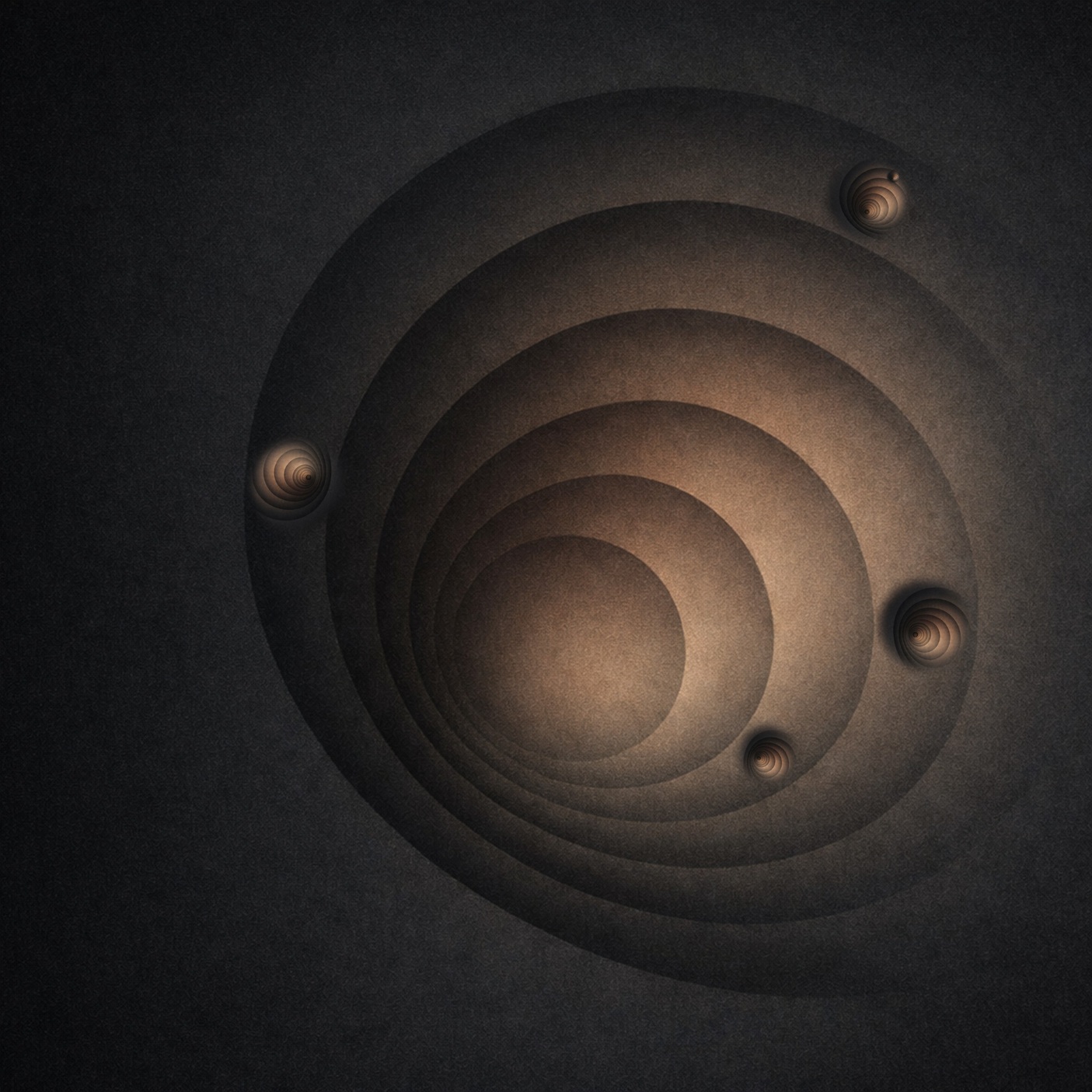
Particles behave reliably, so we name them. Naming encourages reification. But stability does not imply independence. A whirlpool is real, measurable, and persistent—yet it is not a thing separate from water. It is a stabilized structure of the medium.
Nested Reality treats particles in the same way: as localized intensifications within continuous density fields. They are not the building blocks of reality, but its temporary resolutions.
Density, in this framework, is not merely mass per volume. It is resistance to reconfiguration—how strongly a region preserves its structure against change. This intuition already governs how we experience crowds, fluids, environments, and effort. Nested Reality invites us to take it seriously at all scales.
From Empty Space to Continuity
Empty space has never been observed—only regions of decreasing interaction. Yet vacuum is routinely assigned energy, pressure, fluctuation, curvature, and expansion. At some point, "nothing" begins doing too much work.
Nested Reality resolves this tension by treating space as the lowest-density limit of material continuity, not as absence. Emptiness becomes a limit case, not a category of being.
Once continuity replaces void, action-at-a-distance dissolves. Motion no longer requires bridges across nothingness. Everything adjusts within something.
A Calmer Universe
When motion is understood as adjustment rather than compulsion, the universe becomes quieter—but more constrained.
Nothing is yanked across space. Nothing acts violently at a distance. Everything responds within nested contexts.
Orbit becomes balance in motion. Rotation becomes managed instability. Evolution unfolds through admissible gradients rather than abrupt jumps. Life is not an exception to physics, but a continuation of crystallization into regulation.
This is not poetic language. It is structural economy.
Why This Matters Now
If adopted seriously, this framework could:
- Reorient foundational physics education toward structure over force
- Provide a conceptual bridge between physics, systems biology, and cognition
- Reduce reliance on ad-hoc ontological patches in cosmology
- Offer a non-violent metaphysical language compatible with science
- Influence future integrative theories of matter and life
This is not a quick revolution. It is a long-arc shift—one that grows more relevant as science continues moving toward continuity, emergence, and relational structure.
Not a Belief—A Perspective
Nested Reality does not ask for belief. It asks for attention.
It does not replace equations. It reorders what equations describe.
If the ideas feel unsettling, that is intentional. Every genuine shift in understanding begins with discomfort—not because something is wrong, but because something deeply assumed is being seen clearly for the first time.
If nothing is pulling, if space is never truly empty, and if objects are stabilized patterns rather than isolated things— what kind of universe have we been living in all along?
That question is the beginning—not the end—of Nested Reality.