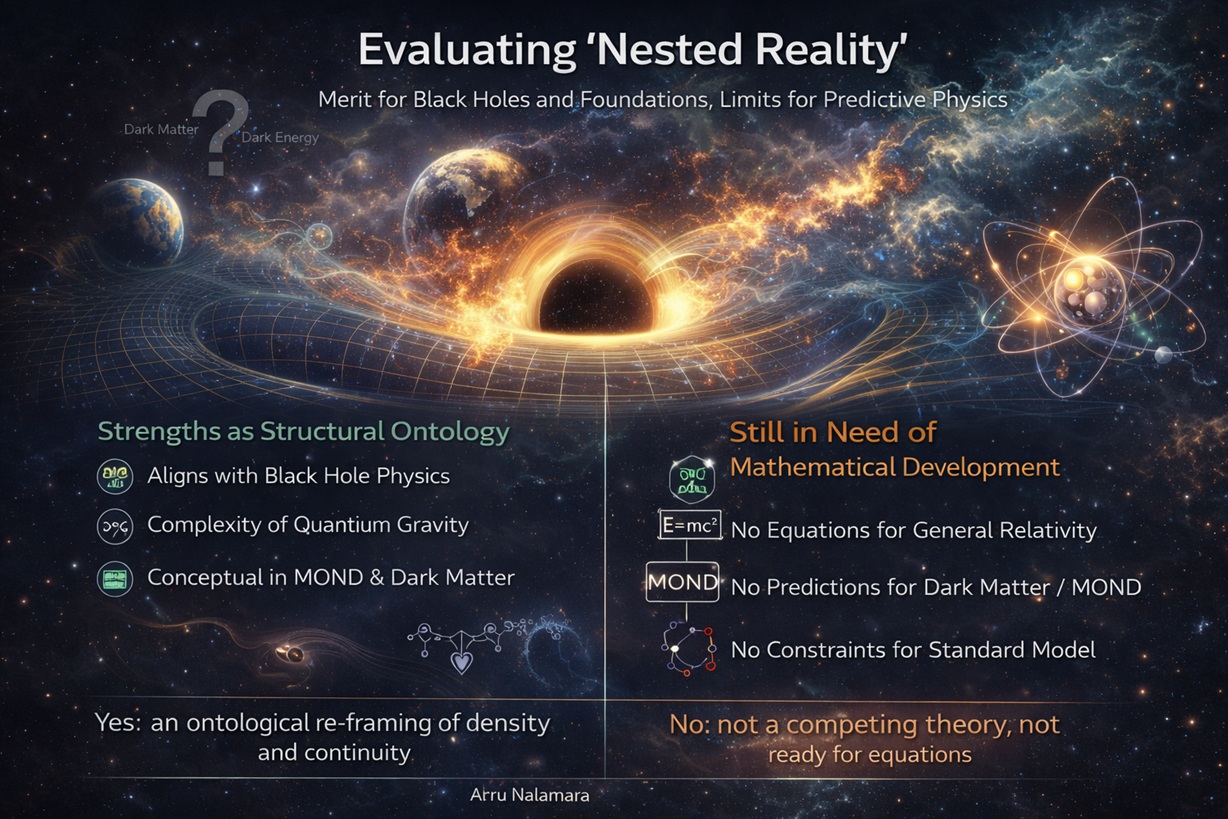
An Evidence-Based Assessment of Nested Reality
An ontological framework for black holes, quantum gravity, and the foundations of physics
Modern physics is extraordinarily successful — but it is also conceptually strained.
General Relativity treats spacetime as geometry.
Quantum field theory treats particles as excitations on that geometry.
Cosmology patches observational gaps with dark matter and dark energy.
Black holes expose deep contradictions between all of them.
These are not merely mathematical tensions. They are ontological ones.
Nested Reality was written to address this fracture — not by proposing new equations, but by examining the conceptual primitives we silently rely on when we write them.
This is an honest evaluation of where that framework has real merit — and where it does not yet reach.
What Nested Reality Actually Is
Nested Reality is not a competing physical theory.
It does not replace General Relativity.
It does not modify the Standard Model.
It does not generate new predictions.
It is a structural ontology — a way of re-describing what the equations are already telling us about the world.
Its central move is simple:
Instead of treating particles, forces, and empty space as fundamental, it treats density, continuity, and admissible change as fundamental.
Everything else becomes structure.
Why This Matters in Foundational Physics
Physics today works — but its metaphors are fractured.
In GR, gravity is curvature.
In QFT, forces are fields.
In cosmology, vacuum has energy.
In black holes, spacetime becomes pathological.
These frameworks coexist mathematically but not conceptually.
Nested Reality identifies this as an ontology mismatch.
We are describing one universe with incompatible primitives.
That is not a technical error.
It is a conceptual one.
Density as a Primitive Is Not Naïve
Physicists already use density everywhere:
- Energy density in GR
- Probability density in quantum mechanics
- Vacuum energy density in cosmology
- Mass–energy density as curvature source
Nested Reality simply makes this explicit:
Density is not just a number attached to matter.
It is the resistance of structure to reconfiguration.
Once this is taken seriously, motion no longer needs force.
Stability no longer needs objects.
Space no longer needs emptiness.
It becomes a continuous field of varying resistance, organizing itself into nested regimes of persistence.
Where Black Hole Physics Becomes Relevant
Black holes are where Nested Reality resonates most strongly with mainstream research.
Black holes already behave like nested realities:
- The interior is inaccessible to exterior observers
- Horizons act as structural boundaries
- Information appears distributed across layers
- Geometry becomes observer-dependent
This aligns naturally with:
- Black hole complementarity
- The holographic principle
- Baby-universe and interior–exterior dualities
A density-based, nested ontology provides a natural language for these phenomena — not as multiple universes, but as layered regimes of structural persistence.
Among black-hole researchers, this belongs in the category: interesting, coherent, speculative — not dismissible.
MOND and Dark Matter
MOND exists because gravity behaves differently at low accelerations.
A density-based ontology gives a conceptual reason why this might happen: spacetime and gravitational response may vary with environmental density.
But without equations, MOND researchers cannot use it operationally.
So Nested Reality is compatible, not yet useful.
Where Nested Reality Does Not Yet Succeed
Scientific credibility requires admitting limits.
Nested Reality does not yet constrain equations.
A physicist will ask:
What calculation changes if I adopt your view?
Right now, the answer is:
None — yet.
That places Nested Reality in the domain of natural philosophy, ontological interpretation, and conceptual unification — not yet in predictive physics.
Particle physicists, in particular, require Lagrangians, symmetries, and experimental consequences. Nested Reality does not yet provide these.
The Honest Conclusion
Nested Reality has real merit — not as a predictive theory, but as a coherent structural ontology for foundational physics.
It speaks most clearly to:
- Black hole researchers
- Quantum gravity theorists
- MOND and dark-matter alternatives
- Scientists dissatisfied with today’s ontological patchwork
It is not ready to replace equations.
It is ready to replace metaphors.
And metaphors, in the long run, determine what equations we are even able to write.