What If Nothing Is Actually Pulling?
A radically simple explanation of gravity, space, and existence—without forces, particles, or speculation.
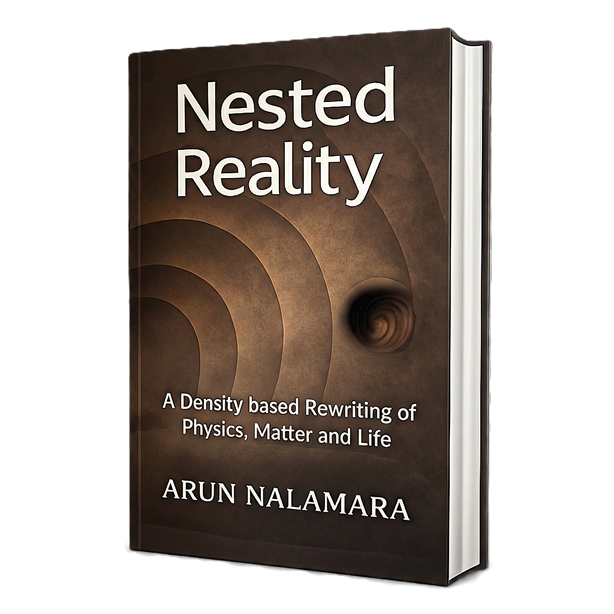
This Book Is For You If...
You're curious about physics but frustrated with overcomplicated explanations
You question standard explanations that work mathematically but fail intuitively
You believe reality should make sense without invisible patches and speculation
You'll never think about gravity the same way again.
The Universe is Simpler Than We Are Told.
We are taught that things move because they are pushed or pulled. We are told space is empty. But if gravity is a force, why did Newton refuse to explain it? If space is empty, why does it bend?
Modern physics has become a patchwork of invisible fixes—Dark Matter, Dark Energy, and Virtual Particles. Nested Reality offers a different view: A universe not of forces, but of density. Not of emptiness, but of continuity.
The Myth of Empty Space
Space is not a void. It is the lowest-density limit of material continuity. See why "nothing" never actually exists.
Motion Without Force
Nothing pulls. Nothing pushes. Objects move to resolve density imbalances. Gravity is not an action; it is an adjustment.
Life as Structure
Life is not a miracle that defies physics. It is matter that has learned to regulate its own density gradients.
"For those who feel standard explanations work mathematically but fail intuitively—this is the book you've been waiting for."
Not Ready to Buy?
Get Chapter 1 Free — No Math, No Jargon
Read how gravity works without forces. Decide if this perspective resonates with you.